
This column originally appeared as part of Tribune Content Agency’s Humor Hotel package, October 27, 20265
I’ve never considered myself a procrastinator, but I’ve decided it’s time to tackle all those household projects I’ve recently been avoiding.
After all, Aug. 14, 2046 will be here before I know it.
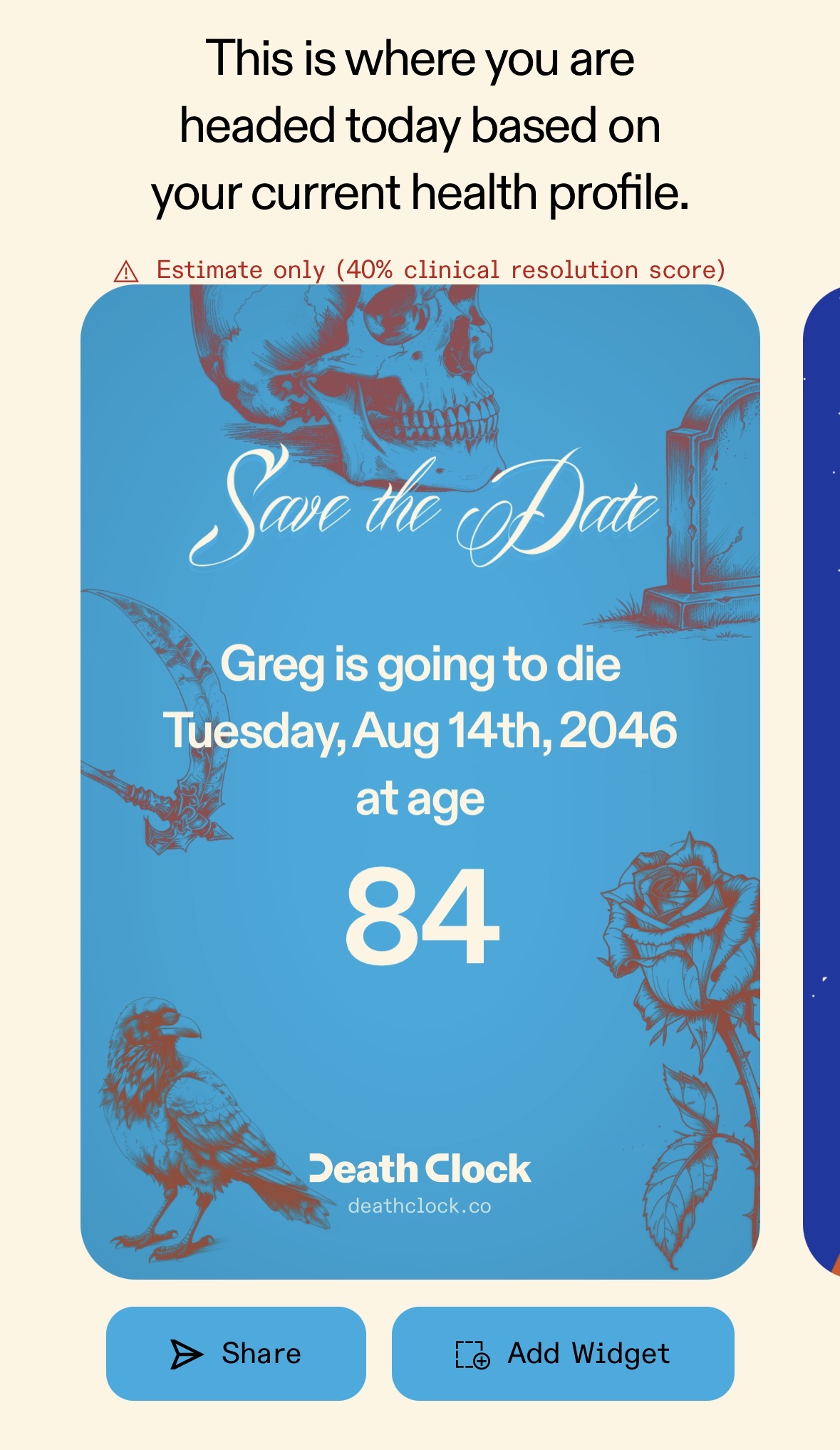
That is the date I will leave this earth. At least according to Death Clock: The Life Lab, the morbidly named “health and wellness” app that predicts when users will meet their demise. As Halloween approaches, what better time to learn about one’s own mortality?
What is the Death Clock App?
Launched in 2024 by entrepreneur Brent Franson, the app encourages users to make lifestyle changes that could add years to their lives. That could mean eating more broccoli or getting a simple blood test. The latter is included with a paid subscription of $69.99 annually or $14.99 per month.
Death Clock, Franson said, morphed from a mental health app idea he dubbed “Most Days.” Franson, who struggled with marijuana and alcohol addiction in earlier years, likened Most Days to a habit tracking intake form used by mental health facilities. Silicon Valley investors were interested but, he admits, not overwhelmed with enthusiasm.
Seeing a likely death date on one’s phone seemed more engaging, Franson said, although the concept was originally called Most Days. Death Clock was more of a tongue-in-cheek title employees used around the office. The Death Clock staff is small — around six employees — but also contains a board featuring clinical physicians and chaired by an oncologist from the Stanford School of Medicine. Eventually, Franson said, the new name stuck.
More than 1.5 million users have downloaded Death Clock. Upon sign-up, they discover their life expectancies via a series of questions on subjects ranging from daily vegetable intake to water consumption to social habits and marital status. I am recently divorced and not sure if that information contributed to my death date. I do know it would play a role if the app were called “Financial Death Clock.”
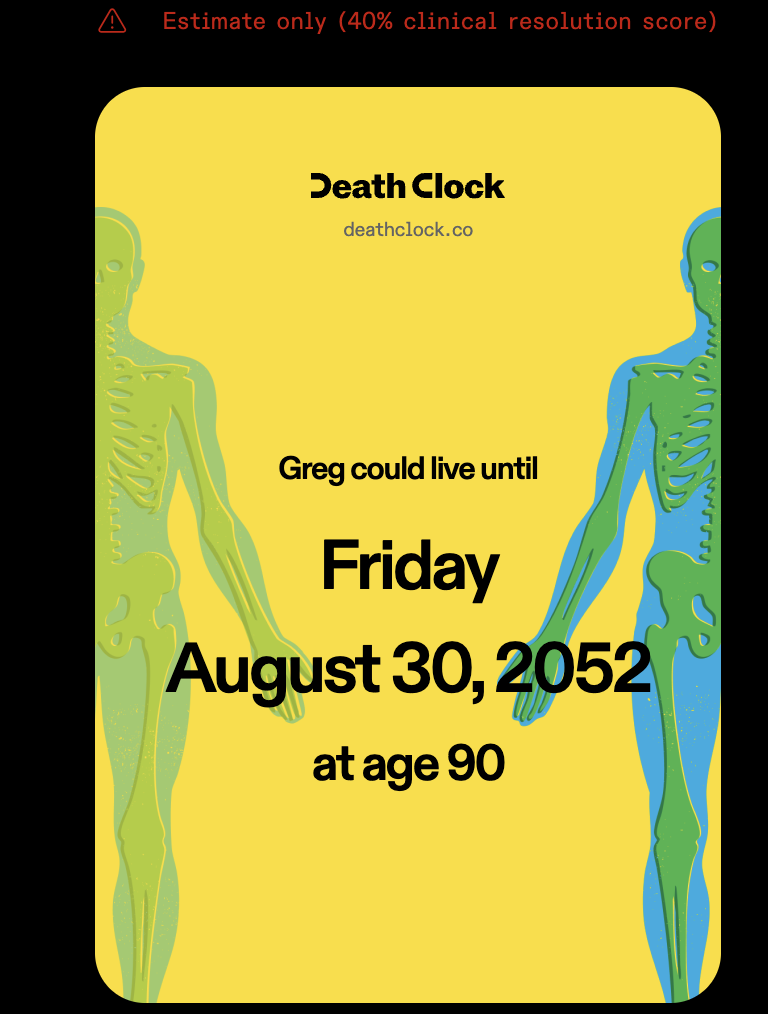
The AI-driven app then crunches that data with numbers derived from longevity studies and life expectancy tables. Eventually the app spits out an expected death day and calendar year. My day was accompanied by a graphic featuring a skeleton floating in a pool on what appeared to be a sprinkled donut.
“We’re trying to lighten it up,” Franson said.
Clear Your Calendars Everyone
The user also has the option to create a “save the date” message featuring, in my case, a simple, “Greg is going to die Tuesday, Aug 14th, 2046 at age 84.” With the exception of my 90-year-old mother, I have already forwarded this information to my friends and relatives in hopes they can clear their schedules. For the record, I have already left instructions in my will for what I KNOW is going to be a rockin’ Celebration of Life party.
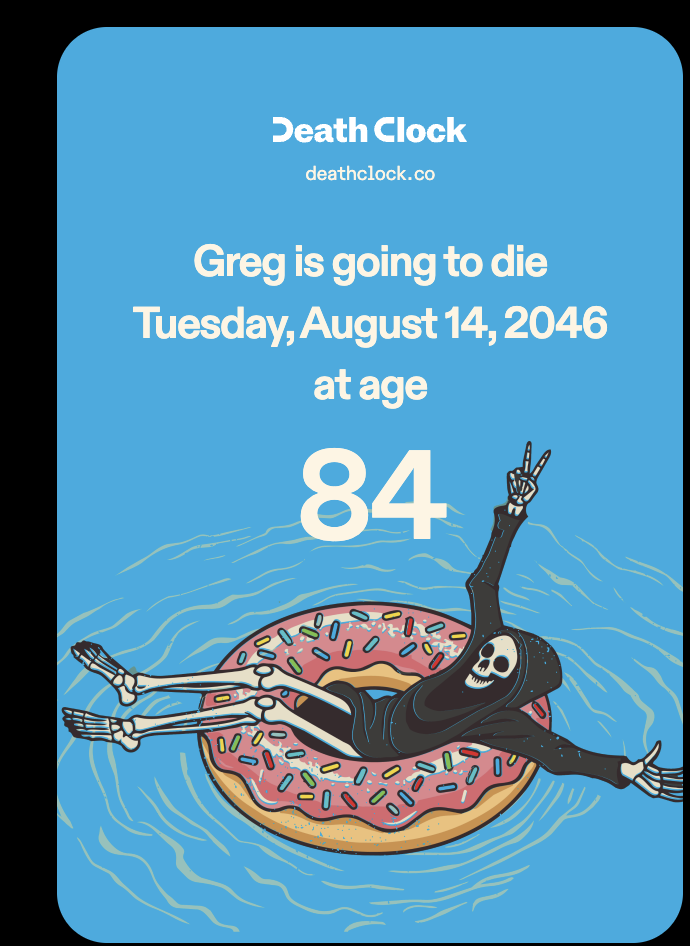
I’m fine with a life expectancy of 84, even though Death Clock says I could reach 90 if I made a few lifestyle changes. At least Death Clock didn’t tell me I was going to die in the coming months. Franson said a prediction like that is highly unlikely.
“It’s only predicting based on preventable health,” he said. “it’s not like an astrologist that’s going to say, ‘Hey, I think you’re going to get hit by a bus next week.’”
Considering I just renewed my city bus pass, that’s a relief. But knowing I only have 20 remaining years has caused me to rethink a few impending decisions. Purchasing “lifetime warranties” from Amazon no longer seems like a good idea. Ditto for a 30-year fixed-rate mortgage. Then there’s the dilemma about when to take Social Security.
But I suppose an extra year or two wouldn’t hurt me. I’m headed to the grocery store today and plan to throw some extra vegetables and bottled water into my cart.
Who knows? There might be a concert I wish to see in 2047.