The King of
Corporate Comedy
In an excerpt from Exceptional People Magazine, read how Greg Schwem turned a journalism career into 20+ years of making Fortune 500 boardrooms laugh without a single swear word.
From Newsroom to the Corporate Stage
Imagine you’re seated in a folding chair at a corporate sales conference, squinting in the mid-morning light. Your company logo’d pullover is itchy. As the CEO drones on, your mind wanders to all the other things you’d rather be doing.
Scanning the day’s agenda to see who’s up next, you notice: “Greg Schwem. Corporate Comedian.”
Huh?
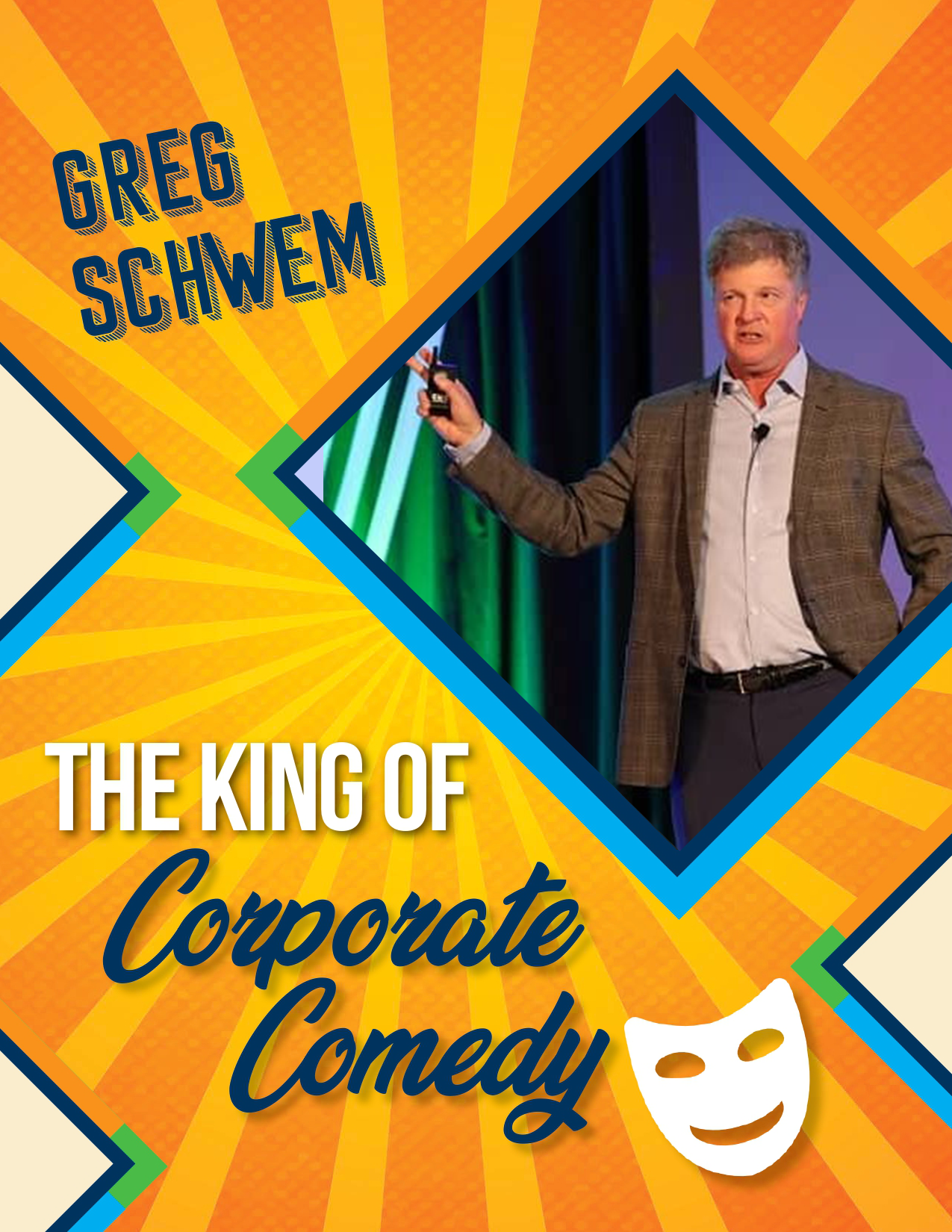
Twenty minutes later, everyone’s rolling in the aisles. This guy is funny. Really funny. He’s nailing your company culture. He doesn’t swear. He doesn’t offend. And he’s getting everyone to laugh in a very unfunny setting.
Crowned “King of the hill in the world of corporate comedy” by the Chicago Tribune, Greg Schwem started practicing his lines as a high school student. But the teen was just as fascinated by television news as he was by comedy. So, he set his sights on highly selective Northwestern University for his undergrad work.
Prestigious journalism degree in hand, Schwem landed a plum job as a reporter at WPTV in West Palm Beach, Florida. But with 1980s media conglomeration came ratings grabs. The Murrow/Cronkite kid couldn’t stomach the news media’s increasing sensationalism. So, he quit and started doing standup full time. Read more about his journey on click here.

His incisive, business-savvy humor was noticed by major corporations. Suddenly he was being hired to perform at company retreats, parties, and presentations. Having started a family, Schwem liked being able to work days rather than nights — and the pay was better. He became known for doing diligent homework about each company before each engagement. He provided motivation, wellness, and best of all, he was hilarious — and he still is.
Technology provides Schwem with a good number of jokes; he’s both fascinated and irritated by it. He even wrote a book entitled Text Me If You’re Breathing about parenting his two daughters during the advent of the smartphone. Actor Ray Romano, of “Everybody Loves Raymond” and “Ice Age,” loves the book, saying “Greg’s hilarious take on the frustrations of parenting in this age of technology made me LOL, ROFL and LMAO (my daughter helped me with those).”
Schwem’s clients include Microsoft, IBM, McDonald’s, Lenovo, United Airlines, and Verizon Wireless. He’s opened for major acts like Jay Leno, Celine Dion, and Keith Urban, and he can also be heard regularly on Sirius/XM Radio’s LAUGH USA.
Schwem’s first love, journalism, also plays a major role in his creativity. He’s a nationally syndicated columnist for the Chicago Tribune, writing laugh-out-loud missives about everything from overuse of the phrase “thank you” to merch suggestions for the pope. He’s been honored by the National Society of Newspaper Columnists for outstanding humor writing, found in the Huffington Post, American Way Magazine, and the New York Daily News.
His second book, The Road To Success Goes Through the Salad Bar: A Pile of BS From a Corporate Comedian, is an anthology of keen observations about his unique vocation.
His TV series, “A Comedian Crashes Your Pad,” hilariously documents his travels and quirky homeshare experiences. Spanning his movements around the globe, Schwem reveals his love of humanity, history, and different cultures while getting his audience to guffaw at the absurdities he finds.
The Onion, the iconic standard-bearer of satire, lauds Schwem for the way he masterfully “Mines comedy gold out of non-sensical corporate speak.”


Clients & Notable Appearances
Monica & Greg: An Exclusive Interview
Exceptional People Magazine founder Monica Davis chatted with Greg recently for insight into his thought process when performing for corporate audiences. Click each question to expand Greg’s full answer.
I started thinking about that in high school. Things like math and the sciences were losing my interest, but I always liked to write. I was always fascinated with TV news, even very early on, when I was eight or nine. I used to enjoy watching the news, and I always thought it would be cool to be them. Then I realized I liked to write. I loved being in front of a camera and the performance aspect of it.
So, I got accepted into Northwestern. But it’s weird because the major that I chose was the wrong major, which was Radio Television Film, a major for aspiring filmmakers. I ended up transferring to a journalist program at the Medill School of Journalism. Eventually, I did get a job in television journalism. I had what I thought was my dream job. I think I was 23 at the time, thinking, “Okay, this is for me.” But my hobby was always stand-up comedy. I started doing that at 16. While in college, I performed around the college campus and dorms.
Then when I moved to Florida, I didn’t know anyone, so I started going to clubs. Little by little, the comedy boom began to explode in the mid to late-’80s. After about a year and a half in TV journalism, I started to get a little disillusioned. My love of TV journalism was starting to dwindle at the same time that my love of comedy was beginning to increase.
What I thought was bad about it 30 years ago has just multiplied exponentially. I am very disillusioned with it. There is still a part of me that misses television journalism. I miss that thrill, that adrenalin rush of covering the breaking news story, which I always really enjoyed.
The problem today is with the internet. People can pretty much write anything without fact-checking. I also get despondent when I hear journalists being spoken about so negatively.
I was scared to death for sure. But I never wanted to look back and say, “I wish I had tried this.” So, I thought, I’ll see if I can make a living at it. If it doesn’t work out in a year, then I’ll reassess. But I was fortunate. The fact that I was a journalist helped me in my comedy career. It helped me cultivate sources and work the phones, go out and get work, and be proactive. Many comedians don’t do that. As a result, they had to leave the business because they didn’t understand how the industry works. They think it’s all going to come to them, but if they had just a little bit of drive and business sense, who knows where they could have gone.
Well, the first thing you need is a little time. I started thinking about becoming a comedian, probably nine months before I did it. You also need to think with your brain as opposed to your heart. Have a plan for how you’re going to make money. Do you have a backup plan for when money is not coming in right away? You have to pay your bills and survive. You have to make money. How are you going to do that?
That didn’t happen right away. I was a club comedian when I started. I was the guy who thought that’s how you did it because that’s what I saw everybody else doing. You went from club to club. I was spending much time on the road driving. I was usually the opener or the middle act on a three-person show.
The first thing I did was move back to my hometown of Chicago. After a year, I started to realize that I could do this for the rest of my life and not get anywhere.
While attending a trade show one day, I connected with a company that hired me as a writer and as a performer. They wanted me to write entertaining presentations — for products, high-tech events, even medical shows or manufacturing. Then they hired me to be the spokesperson for a lot of those things. I was learning how to make people laugh about very technical subjects in a short amount of time.
People came to me after shows and said, “You just described what’s going on in our office. Would you like to do that for our company retreat, our office, our Christmas party?” I started to get hired by companies to do just that. That involved a lot of customized writing. I was good at it, and very few people were doing comedy or humor in the business environment.
It came with better hours, better accommodations, better money. Then, before I knew it, I stopped doing clubs — and that was 20-some years ago.
I think just being able to laugh improves productivity. My goal is to have people leave the event feeling better than when they walked in. I want them thinking this is a pretty cool place to work because they hired that guy. They hired that guy to make us laugh about what we do.
Everybody needs to laugh at some point during the day, even in times when things are not going so well. If you can leave work after eight hours and go home and somebody asks how your day was, included in that response can be, “Oh, the funniest thing happened at work today” — and that’s pretty cool.
First, I’ve never had somebody say we can’t hire you because you’re too clean. The minute you insert profanity into your act, you have just eliminated a segment of places where you can work.
Second, I think there’s a lot of subject matter available that you can mine without having to resort to swearing. You start by working clean, and you just say, “I’m not going to do it,” and then you don’t have that to fall back on.
I’m always trying to write, and I’m always listening and reading. I’ve added visual humor into my shows, including funny photos. We’ve become a very visually-based audience these days. It’s harder for people just to sit and listen now because we need to be stimulated all the time because we’re on our phones all the time.
I enjoy going to work. I have never said, “I don’t want to do this,” or, “I don’t want to be here,” and that’s very rare. I think most people get up in the morning, and they go to work, not wanting to be there, and they don’t love their job. I have always had a job that I love.
I think you have to have some sort of talent to even go on stage the first time. I would say, after that, it becomes a learning process. I would say it’s probably 40% talent and 60% learning.
I would say, watch as many different types of comedians as you can because you can learn from all of them. There’s enough of them out there now where you can do that.
Then try to figure out who you are, and figure out your voice. Don’t try to imitate somebody else because everybody’s different. Everybody has a unique personality. You can learn from everyone, but don’t try to mimic what comedians do.
To create. Always be creating. I think a word like that just encourages everybody to realize that every day is a new day. Every day you can do something that you didn’t do yesterday.
Before You Make the Leap
Greg’s advice for anyone contemplating leaving their job or career to pursue their true calling from the man who left a dream journalism job to become America’s top corporate comedian.
Give Yourself Time
Start planning months before you leap. Greg spent nine months thinking it through before leaving journalism for comedy full time.
Think With Your Brain
Think with your brain, not your heart. Have a concrete plan for how you’re going to make money before you take the plunge.
Have a Backup Plan
Do you have a backup plan for when money is not coming in right away? You have to pay your bills and survive.
Learn the Business Side
Many talented people fail because they don’t understand how the industry works. They think it’s all going to come to them.
Find Your Own Voice
Learn from as many people as you can — but don’t try to mimic anyone. Everybody has a unique personality and voice.
Always Be Creating
Every day is a new day. Every day you can do something that you didn’t do yesterday. Keep creating — always.
“Always be creating. I think a word like that just encourages everybody to realize that every day is a new day. Every day you can do something that you didn’t do yesterday.” — Greg Schwem · Corporate Comedian